
You're probably picturing afternoons in the pool long before you think about selling your home. Still, if you're planning a swimming pool for your Mackay backyard, it's reasonable to wonder whether it could add property value later.
If you decide to sell one day, the pool will become part of how buyers see your property. It might strengthen your home's appeal, but its effect on resale value is harder to predict.
We'll look at what influences a pool's value, how pool types compare, and what appeals to future buyers. That way, you can plan a backyard you'll enjoy now with a better understanding of what may matter later.
Highlights
- A swimming pool may increase your Mackay home's value, but there is no guaranteed premium.
- Neighbourhood, Mackay's climate, buyer demand, property type, backyard space, design, and pool condition can all influence the final resale value achieved.
- The type of pool can affect resale value, whether it's concrete, vinyl-lined, or fibreglass, depending on buyer preferences.
- A swimming pool can reduce resale value when buyers see it as an unwanted feature and offer less for it.
- Improved sale prices may still fall short of full installation costs, whether you choose DIY or professional installation.
- Suitable design, tidy surroundings, efficient equipment, safety compliance, maintenance records, and good photos can make a pool more attractive to buyers.
- High running costs, leaks, ageing equipment, safety problems, poor drainage, and unfinished surrounds can deter potential buyers.
- Compare recent sales of similar homes with and without pools, then consult Mackay agents or valuers for realistic estimates.
How Much Value Can a Swimming Pool Add?
A swimming pool can increase your Mackay home's resale value, and we believe a well-planned pool can be a valuable addition to a family property. However, we wouldn't promise an extra $30,000 or a fixed percentage. The amount depends on what buyers are prepared to pay for the finished home.
There's good reason to be positive about Mackay. In the first half of 2026, the median house price reached $725,000, and local valuation findings showed buyers paying premiums for established family homes with improvements such as pools. That's encouraging for homeowners, although the findings don't reveal how much value the pool alone contributed.

From our experience as pool installers, we believe a pool has better resale potential when it fits naturally into the property and complements the available outdoor space. Buyers may be willing to pay more for a home with a finished swimming area they can use straight away. Still, we wouldn't assume that spending more on a pool automatically produces a larger premium.
Suppose two otherwise similar homes sell for $700,000 and $740,000, with only the second property featuring a swimming pool. The $40,000 difference could suggest a pool-related premium, although other property differences would still need to be considered. That's only a hypothetical example. We'd want to know whether other improvements influenced that difference before attributing the full amount to the pool.
Our advice is to regard potential resale value as an added benefit when planning your swimming pool. Mackay's market gives us reason to be optimistic, but the real value will become clearer when your home is assessed against competing properties.
What Factors Affect How Much Value a Pool Adds?
A pool's influence on a selling price depends on the market around the home. A feature that attracts strong interest in one suburb may carry less weight in another, even when the pools themselves are much the same.
To understand the possible contribution to resale value, we need to look at nearby sales, weather conditions, and the expectations people bring to a property inspection.
Local Market and Comparable Sales
Mackay's suburbs don't all compete in the same property market. Buyers looking at established homes in West Mackay may have different budgets and expectations from those searching along the northern beaches.
The number of pools nearby can shape buyer expectations. If most competing homes already have one, a pool may be considered standard. Where they're less common, a pool can stand out without necessarily commanding a higher selling price.
A sale also reflects market conditions at that particular time. During a period of limited housing supply, buyers might compete strongly for an attractive home. When more properties are available, they may have greater room to negotiate. Those shifts can influence selling prices independently of whether a property has a pool, making the timing of comparable sales important.
Where a suburb has few recent sales of homes with pools, a valuer may consider properties further afield and adjust for differences in location or other features. The fewer close comparisons available, the more professional judgement the assessment requires.
Climate and Buyer Demand
Mackay's tropical climate provides warm weather for much of the year. Compared with cooler regions, the longer period of suitable weather may make having a pool more attractive to prospective buyers.
That said, prospective buyers have different priorities. One buyer may specifically search for homes with pools, while the other would rather avoid owning one. A property attracting several keen pool buyers may achieve stronger offers, but the outcome depends on who is actively searching when it goes on the market.
Property Type and Backyard Space
The type of property matters as buyers expect different things from different homes. A pool may feel appropriate at a larger family house, especially in an established suburb, but less appealing in a compact townhouse where outdoor space is already limited.
The advertised block size can also be misleading. Once you account for the house, sheds, sloping ground, and other structures, there may be much less usable yard than expected.
A pool that still leaves room for everyday outdoor activities could contribute more to a home's appeal than one that uses nearly all the available space.
Pool Design and Placement

A pool's shape and dimensions affect how well it belongs in a particular backyard. Buyers assess the pool alongside the home, including the space available to move around it and how easily the yard connects to other outdoor areas.
Sun exposure and shade matter when judging the position of a pool in Mackay. Nearby buildings, fences, and mature trees can change when the water and surrounding area receive direct sun. Some shade can make the poolside more comfortable during hot weather, but the best balance depends on how the space is used.
Design choices can also date a property or make it feel consistent with the house. Strongly themed finishes may appeal to fewer buyers, while a design that suits the home's architecture may have broader appeal.
Pool Age and Condition
A pool's age gives buyers a starting point, but it doesn't settle its value. An older pool that remains in good condition may compare favourably with a newer one that has received little care or shows early signs of wear.
A pool is also made up of parts that don't necessarily wear out together. The shell, interior finish, and filtration equipment can be in very different states, depending on use and maintenance. Because of this, two pools installed in the same year may have different remaining service lives and could make different contributions to the property's assessed value.
Valuers may account for physical wear and obsolescence when assessing improvements. That is why an existing pool's contribution depends on its present condition and usefulness, rather than its installation year alone.
Does the Type of Pool Affect Property Value?
The pool's construction material can influence how buyers assess its appearance and future upkeep. However, there is no reliable rule that concrete, vinyl-lined, or fibreglass pools add a particular amount to your home's resale price. Each comes with different strengths and limitations.
Before comparing materials, it is worth separating in-ground and above-ground pools. In-ground pools often appeal more to buyers, although a well-integrated above-ground pool can still be attractive.
Concrete Pools
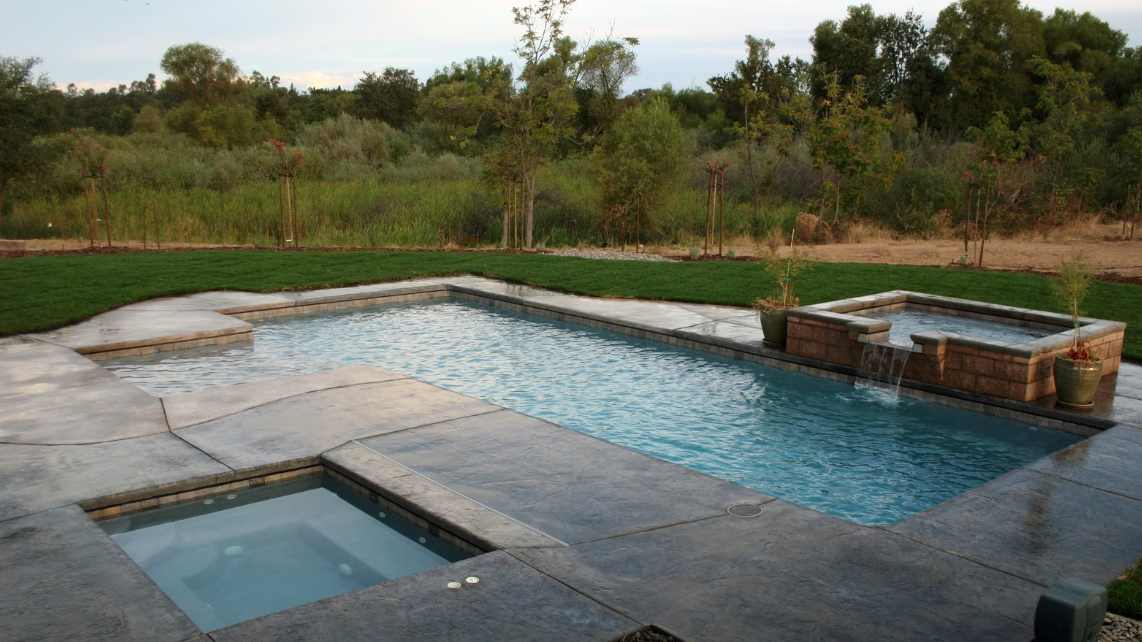
Concrete pools can matter for a high-end home or an awkwardly shaped yard, where a ready-made shell might not suit the design.
A custom concrete pool may complement an architectural home, but expensive construction does not guarantee an equivalent resale premium. Its appearance also depends on the interior finish, which could be tiles, pebble, or render.
When comparing this pool type with others, a future buyer may pay particular attention to the following features:
- Custom dimensions: Irregular yards can accommodate a tailored pool without forcing the design into standard shell dimensions.
- Depth choices: Different depths can suit swimming or shallow relaxation.
- Finish options: Tiles, pebble surfaces, and render create different appearances, textures, and maintenance expectations.
- Built-in features: Spas, ledges, and overflow edges can be formed during the original build.
- Future resurfacing: Some finishes require renewal after years of regular use.
- Buyer fit: Strongly customised features may appeal to certain buyers but feel unnecessary to many others.
Vinyl-Lined Pools
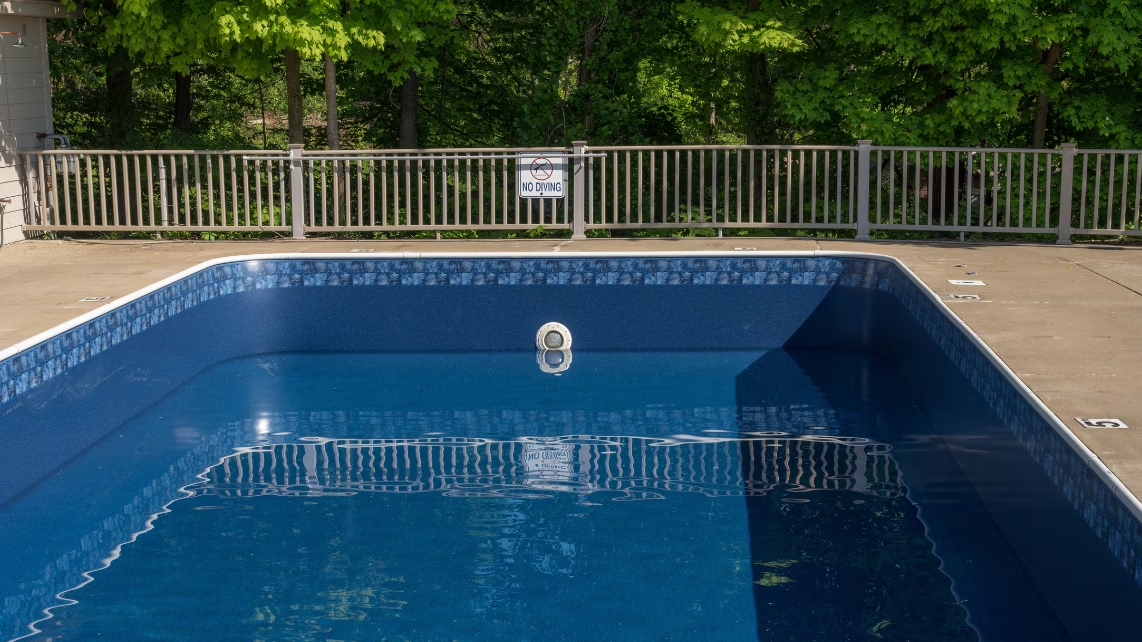
Vinyl-lined pools are less common in Australia than concrete or fibreglass pools. For resale, buyers may pay close attention to the lining itself rather than the pool's age alone.
Points worth considering include:
- Replaceable lining: A new liner refreshes the interior while keeping the original supporting structure in place.
- Surface feel: Vinyl feels different from rougher, textured pool interiors.
- Colour options: Replacement liners offer new colours or patterns without changing the pool's original shape.
- Wear and tears: Sharp objects can puncture the lining, sometimes requiring repairs.
- Liner lifespan: Sun exposure, water balance, and material quality all affect when the lining needs replacement.
- Underlying structure: The supporting walls may be older than the replacement liner.
- Local support: Buyers may check whether liner replacement specialists are available in their area.
Fibreglass Pools

Fibreglass pools have a smooth gel coat finish, which is generally easier to clean than rougher concrete interiors. For buyers who prefer simpler routine care, that can be appealing.
Fibreglass can be an attractive resale feature when the shell is correctly installed and has been properly cared for. Its finish and construction appeal to buyers who prefer straightforward pool ownership.
Fibreglass pools also have limitations worth considering before assuming they will attract a higher resale premium:
- Smooth gel coat: The non-porous, less abrasive surface generally requires less scrubbing than rougher pool finishes.
- Moulded steps: Entry steps are integrated into many factory-made designs.
- Design choice: Compact plunge pools, family shapes, and lap-style shells offer variety within a manufacturer's available range.
- Size limits: Shell dimensions and transport access may restrict which designs a backyard can accommodate.
- Surface upkeep: Gel coat can still fade or need specialist repairs over time.
- Warranty terms: Buyers should check cover, exclusions, and whether the warranty transfers when the home is sold.
Can a Pool Lower Your Home's Resale Value?
A swimming pool can lower a home's resale value if buyers would rather have the property without it. That outcome is possible even in a warm region such as Mackay.
There's a difference between a pool that adds nothing to the price and one that brings the price down. In the first case, buyers may simply give the pool little financial weight. In the second, they could offer less for the entire property than they would for an otherwise similar home without a pool.

A pool may also change how many people consider making an offer. Fewer interested buyers can weaken competition, especially when a seller needs several strong offers to reach their asking price. However, a smaller buyer group does not automatically mean a lower final sale price.
Two people inspecting the same house might make very different decisions about its pool. One may regard it as part of the home's appeal and bid accordingly, while the other may like the house but factor an unwanted pool into a lower offer.
If you already have a swimming pool, we'd recommend getting local property advice before deciding to remove it ahead of a sale. You could spend money changing the backyard only to find that some buyers preferred it as it was. The sensible approach is to assess the likely effect on the whole property's value before making a permanent change.
Will You Recover Your Pool Installation Costs When Selling?
You may recover all of your pool installation costs when you sell, but there's no guarantee. A higher selling price doesn't mean the pool has paid for itself. What matters is how much value buyers place on it.
To judge that return properly, start with everything you spent creating the finished pool area. Excavation, fencing, drainage, paving, and other site work can make a substantial difference to the final figure, particularly on Mackay properties where access or ground conditions complicate the build.
Say your pool project costs $75,000 and the pool adds $45,000 to your home's resale value. You've recovered $45,000 through the sale, leaving a $30,000 gap against what you spent. These are example figures, not a Mackay valuation or a prediction of your own result.
The timing of your property sale also affects the calculation. A pool built shortly before selling has a different cost history from one installed ten years earlier. Over time, repairs and running costs add to your spending, while any general rise in the property's price shouldn't automatically be credited to the pool.
A DIY fibreglass kit may cost less upfront, but it doesn't guarantee a better resale return than professional installation. Buyers judge the finished pool and its condition. For that, we'd suggest choosing the approach that suits your skills and budget, without depending on a future sale to repay the bill.
What Makes a Pool More Appealing to Buyers?

Buyers can appreciate a swimming pool more easily when the surrounding area feels ready to use and everything seems straightforward to manage.
Tidying the pool area or updating the photos will not necessarily increase its market value, but a clean, functional space may encourage people to inspect the property and make an offer.
The details worth considering include:
- Suitable pool size. Leave room for outdoor seating and everyday activities, so the backyard remains useful beyond the pool.
- Easy pool access. Make the route from the house clear and easy to follow, with enough walking space around furniture and the pool edge, especially when several people are outside.
- Attractive pool surrounds. Tidy paving, established garden beds, and well-finished edges make the pool area look complete, even without expensive decorative additions.
- Low-maintenance finishes. A smooth fibreglass finish can appeal to buyers who want less routine scrubbing, although it still needs regular cleaning and proper water care.
- Energy-efficient equipment. Show the pump's energy rating, if available, and explain its settings, especially when you've installed an efficient variable-speed model.
- Practical pool features. Built-in entry steps, seating ledges, and a cover designed for the pool may be easier for buyers to appreciate than expensive features with little practical use.
- Compliant pool fencing. Check gates close and latch correctly, confirm the barrier meets Queensland requirements, and provide a current safety certificate if one is available.
- Maintenance and warranty records. Collect service invoices, manuals, and relevant approvals, plus warranty paperwork that buyers can review before committing.
- Quality listing photos. Show the water clearly in daylight photos and include a wider view of the backyard.
What Can Put Buyers Off a Home with a Pool?
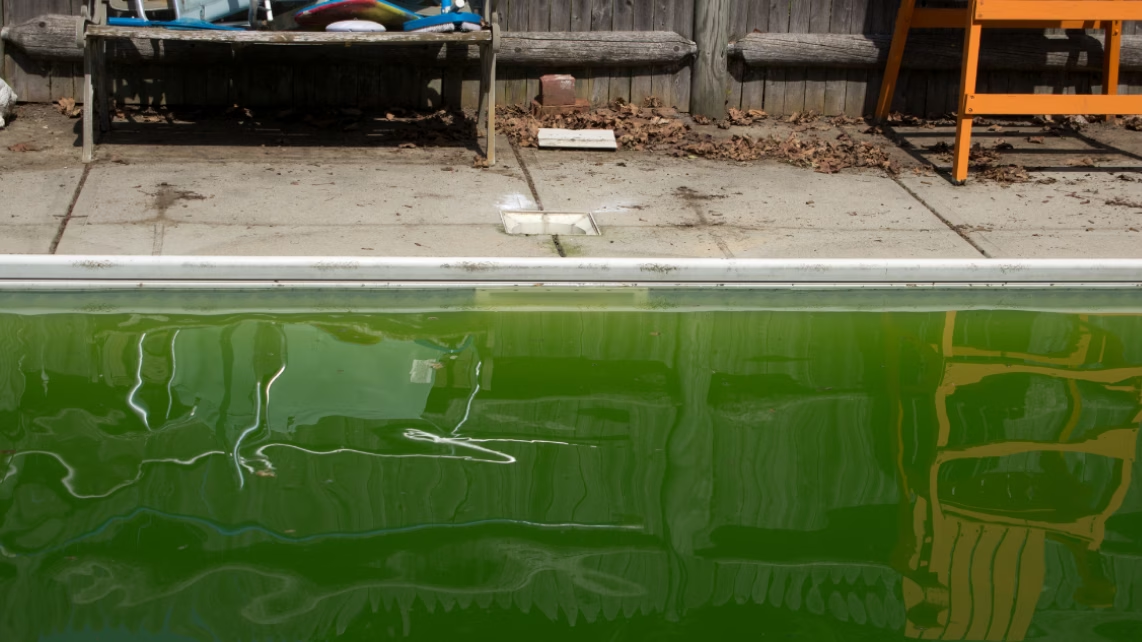
A buyer might love the house yet hesitate over the pool if it appears likely to bring immediate expenses or responsibilities they cannot assess during a viewing.
Common concerns include:
- High running costs. Electricity, chemicals, and regular servicing can look expensive to buyers, particularly when the seller cannot explain typical spending.
- Leaks and structural damage. Unexplained water loss, cracks, or movement around the shell may suggest a repair that needs specialist assessment and could cost far more than a simple cosmetic fix.
- Ageing equipment. A noisy pump or unreliable chlorinator can make buyers budget for replacements soon after moving in, even when the water looks clean.
- Poor drainage. Standing water after heavy rain may suggest runoff or groundwater problems that need investigation before buyers feel comfortable committing.
- Limited backyard space. A pool that occupies nearly the whole yard may deter buyers who want room for pets, outdoor meals, or children to play without swimming.
- Awkward pool placement. Difficult access around the pool or an inconvenient path to the house can make the outdoor area feel cramped.
- Poor installation work. Uneven coping, sinking paving, or unexplained repairs can leave buyers wondering whether the original installation was completed properly and what hidden problems might remain.
- Unfinished surrounds. Exposed soil, rough edges, or incomplete paving give buyers extra work to organise, with an uncertain final cost.
- Insurance concerns. Prospective owners may need to check if the pool is covered, what events are excluded, and whether the property attracts a higher premium under their chosen policy.
How to Estimate a Pool's Impact on Your Property Value
Compare Similar Home Sales
Start by checking recently sold properties in your suburb on realestate.com.au or another Australian property listing website. Look for examples with a pool and without one, noting confirmed prices and dates.
Pay attention to when each sale occurred. If one house sold several months before another, changing market conditions could explain some of the difference. Keep a record of addresses, dates, features, and prices, and mark any properties you aren't confident about comparing.
Consult Local Property Experts
Ask a Mackay agent with recent sales in your price range for a comparative market analysis. Queensland generally requires at least three sales of similar properties within five kilometres and six months. If suitable sales aren't available, the agent must explain their opinion in writing.
Request two estimates where practical: how your home may sell with a suitable pool and how a similar home without one is likely to perform. Ask the agent to identify the sales behind each opinion and explain any adjustments.
For an investment of this size, consider a Queensland-registered property valuer. Always ask whether they can assess the likely contribution of a proposed pool and what sales evidence supports that estimate.
Know Your Likely Buyers
Look at who the competing homes are designed to attract. A four-bedroom house near schools may be marketed to families, while a compact home may appeal to a different group. These descriptions provide a starting point for researching demand, although they don't necessarily prove how much those buyers would pay for a swimming pool.
Ask agents whether recent buyers requested pools or raised objections during inspections. Then ask whether those reactions showed up in offers for comparable homes.
If you're planning a pool, gather this feedback before choosing a design or committing to the budget. And if recent sales are limited or opinions are mixed, keep your estimate conservative and don't rely on a resale premium to fund construction.
So, Is a Pool a Worthwhile Property Investment in Mackay?

If you ask us, a pool is worth having when you'll spend years enjoying it. Think of weekend swims with the kids, cooling off after a hot Mackay day, or inviting friends over. That's the real reason to build one, with future resale value a bonus.
Mackay's market gives us reason to be positive about well-presented family homes with pools. However, today's buyer demand may look different when you eventually sell. A future buyer will judge your whole property against other homes available at the time, and the price they offer may not reflect everything you've invested in the pool over the years.
We often recommend fibreglass pools to Mackay homeowners because their smooth finish makes routine cleaning easier, and the available designs suit a range of backyard sizes. However, we can't promise that a fibreglass pool will always fetch a bigger resale premium than other types.
Concrete remains a reasonable choice when a property needs a highly customised pool shape or finish. We'd rather explain where each option works best than claim one material will suit every home or guarantee the most value at resale.
If resale value really matters to your decision, ask a local agent or registered valuer about comparable homes before you build. Consider their assessment alongside how much you'll use the pool. That way, your decision won't depend on a future sale price nobody can promise today.
Final Thoughts
A swimming pool can add resale value to your Mackay home, although there's no guarantee you'll recover everything you spend. For many Mackay homeowners, fibreglass is a practical choice because of its smooth, low-maintenance surface. Still, choosing the right pool for your property matters more than chasing a promised return.
Before committing to a new pool, speak with a local property expert about comparable sales in your area. Then compare that advice with a detailed installation quote, including the surrounding work, so you understand the full investment.
If you ever need help with your fibreglass pool project, just reach out to us. We are licensed installers with years of experience installing fibreglass pools in Mackay, and we're happy to chat or give you a quote.
And if you're still thinking about which fibreglass pool to choose, check out the fibreglass pool designs our partner offers. There's always something for every backyard and budget.